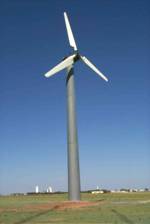
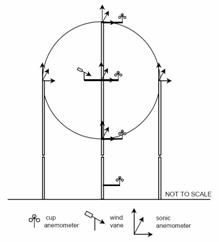
Figures: The LIST wind turbine and primary inflow instrumentation on towers upwind of the turbine
The data sets employed to estimate spatial coherence spectra throughout this study were provided by Sandia National Laboratories through the ongoing Long-Term Inflow and Structural Test (LIST) program (Sutherland et al, 2001). The LIST program has made available continuous time series of atmospheric inflow conditions as well as structural response data for a modified Micon 65/13 wind turbine (referred to as the LIST turbine in this study). This measurement campaign is taking place at the USDA-ARS site in Bushland, Texas which is characteristic of a Great Plains site with essentially flat terrain and the primary wind direction at the site is from 215° with respect to True North. The LIST machine is a three-bladed, fixed-pitch Micon 65/13M wind turbine with a 3-phase 480V asynchronous generator rated at 115kW. Wind turbines currently being operated by utility companies in the United States are about 10 times larger than the LIST turbine and have power ratings on the order of 750 kW.
From the LIST program, inflow and structural response data are recorded and stored as ten-minute segments, each of which contains approximately 18,000 data points, at a sampling rate of 30 Hz (implying a Nyquist frequency of 15 Hz). The experiment is being monitored using a total of 60 sensors. The turbine is fitted with 19 sensors to measure structural response and a tower is fitted with 34 sensors to measure atmospheric conditions. Characterization of the inflow in this study relies on an array of five sonic anemometers mounted on three meteorological towers located approximately 30 meters in front of the LIST turbine. The center tower is directly upwind of the LIST turbine. The other two towers are one rotor-disk radius to the left and right of the center tower. The five sonic anemometers are mounted as follows: at hub height which is 23 meters from the ground; at the top and bottom of the rotor circle; and at positions left and right of the center of the rotor circle. Two additional meteorological towers located in front of the sister turbines, approximately 38 meters away from the center tower on the left and right, were constructed to measure horizontal wind velocities at the hub height using cup anemometers. The additional inflow data from these two towers are used to study the coherence of the along-wind turbulence component with this greater lateral separation. In this study, a total of 491 ten-minute segments are considered.