Data available on inflow and structural response from the LIST program have provided an opportunity to study the influence of various inflow parameters on fatigue and extreme wind turbine loads. A procedure we used employed several steps involving regression of loads on primary and secondary inflow parameters. Residuals obtained in each regression step helped in identifying which inflow parameter might be a candidate for regression after more important parameters had already been considered. A systematic approach was followed for damage-equivalent fatigue loads with fatigue exponents of 3 and 10, and for extreme loads representing root flap and edge bending moments. A reduced data set including only those ten-minute records where the horizontal wind speed was higher than rated (13 m/s) was also employed in an analysis for the sake of comparison with the entire data set. The atmospheric time series data were processed to form an inflow parameter vector which is used as the independent variable. It consists of a primary inflow parameter vector and a secondary inflow parameter vector. It has been widely believed that the horizontal mean wind speed at hub height and a measure of turbulence such as the standard deviation of horizontal wind speed might be considered primary factors that influence fatigue and extreme loads. Accordingly, the primary inflow parameter vector is defined to consist of the statistical mean and standard deviation of horizontal wind speed. The secondary inflow parameter is defined to consist of sixteen secondary inflow wind parameters that include the vertical wind shear exponent, standard deviations of wind speed in the cross-wind and vertical directions, turbulence kinetic energy, three orthogonal Reynolds stresses, local friction velocity, Obukhov length, a Stability Parameter, the gradient Richardson number, turbulence length scales in three orthogonal directions, and the skewness and kurtosis of horizontal wind speed
In general, it was found that when the entire data set was used, the fatigue and extreme loads showed few dependencies on either the primary or the secondary inflow parameters. For extreme loads, the dependencies were more evident than for fatigue especially with the primary inflow parameters. When the reduced data set was employed, the dependencies of loads on inflow parameters were found to be greater than with the entire data set including wind speeds smaller than rated as well. Regression fits on the primary inflow parameters were markedly improved. A few secondary inflow parameters were identified as important especially for fatigue loads.
We presented a procedure to establish nominal loads for the design of wind turbines against ultimate limit states. Three alternative load models were compared. The simplest definition of nominal load is based on a representative load derived from the T-year value of the mean wind speed (X
1) alone and consideration of standard deviation on wind speed (X2) and ten-minute extreme bending load (X3) only by representing these as conditional median values. In this model, uncertainty is neglected in both X2 and X3. A second definition might be based on a representative T-year load that includes randomness in both X1 and X2 but still neglects uncertainty in the short-term load, X3. Again, this load is held fixed at its median level given X1 and X2. Finally, a definition for nominal load could be based on the T-year nominal load including uncertainty in all of the three variables. We refer to these definitions as “1-D”, “2-D”, and “3-D” probabilistic load models respectively. An inverse reliability approach was employed to estimate nominal design loads. For the 600kW wind turbine considered, the environmental and response probabilistic descriptions were obtained from a study by Ronold and Larsen (2000). Extreme flapwise bending loads were studied and, for this turbine, it was found that the difference between the nominal loads derived from 1-D and 2-D models was very small since the standard deviation of wind speed at the hub height had a very small effect on the extreme bending load compared with the mean wind speed. Including uncertainty in the short-term maximum bending load conditional on inflow (in the 3-D model) caused somewhat higher loads than in the 1-D and 2-D models. Two issues related to accuracy of the Inverse FORM predictions were studied. It was determined that the implied use of a linearized limit state function does not lead to significant error in derived loads; this was verified by making second-order corrections using curvatures of the limit state surface. Neglecting response variability, on the other hand, was found to lead to greater error (as manifested by differences in loads derived based on 2-D and 3-D models). A Modified 2-D model was proposed and demonstrated to yield almost similar nominal loads as were obtained with the 3-D model as long as suitably derived “higher-than-median” fractiles for the response variable were obtained first by using some additional computations of gradients of the limit state surface at the 2-D model design point. The attractiveness of the Modified 2-D model is not only the improved accuracy but the fact that the environment and turbine response are uncoupled.
(a)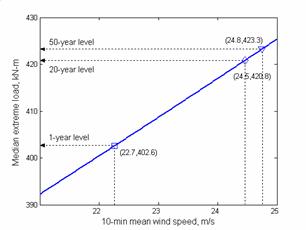
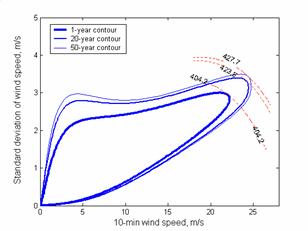 (b)
(b)
(c)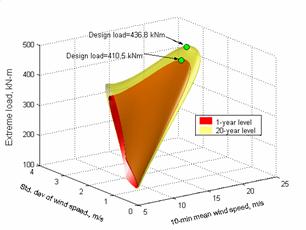
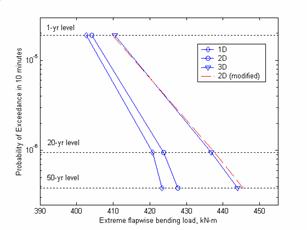 (d)
(d)
Figures: Extreme Flapwise Bending Moment based on Various Models:
(a) 1D, (b) 2D, (c) 3D and (d) Comparisons between 1D, 2D, 3D, and 2D modified
We examined spatial statistics using the LIST program’s measured inflow turbulence by obtaining estimates of power and coherence spectra using ten-minute segments of three components of the wind velocity at several different locations. Coherence spectra for different lateral and vertical separations were studied as were cross-coherence spectra between distinct turbulent components at the center of the rotor circle. Estimation errors associated with coherence spectra described by bias, variance, and confidence intervals were also discussed. The influence of separation distance on along-wind coherence was studied. Estimated uu-coherence spectra based on data were compared with theoretical models. Finally, cross-coherence of different turbulence components was studied. Results obtained for the three different bins defined based on horizontal mean wind speed and standard deviation of horizontal wind speed led to the following general conclusions:
-
The along-wind coherence spectra for both vertical and lateral separations, when expressed in terms of reduced frequency, decays faster with increasing separation.
-
The Davenport model exponential decay parameter was found to depend on the separation distance. The assumption that the inflow coherence spectrum approaches unity at zero frequency is inconsistent with observed coherence spectra for the across-wind and vertical turbulence components. Hence, extending the Davenport coherence model hypotheses for use with these turbulence components is not appropriate.
-
The IEC modified exponential model predictions of the along-wind coherence for small lateral and vertical separations matched the estimated coherence from data fairly well, except at very low frequencies. There, this model predicts lower coherence than was estimated from data. At large separations and low frequencies, the IEC modified exponential model fails to describe the observed fast decay of coherence with reduced frequency.
-
The relative coherence levels of the along-wind, across-wind, and vertical turbulence components for the different lateral separations as estimated based on data were in accordance with the von Kármán model. The different relative levels of coherence found when considering vertical separations may indicate a lack of isotropy in the turbulence structure.
-
Using a required model parameter value as recommended by the IEC standard, the von Kármán model generally overestimated coherence when compared to estimates from data. This was found especially so when studying the coherences of the across-wind and vertical turbulence components, but was also seen when studying the coherence of the along-wind turbulence component, and especially at large lateral separations.
-
Overall, the Mann uniform shear coherence model based on parameters fit with the Kaimal turbulence spectra appears to agree reasonably well with the estimated coherence spectra from data for all three turbulence components although it did underestimate the along-wind coherence for small lateral separations. In particular, the Mann model predicts low-frequency coherence better than other models studied, and the model does especially well compared to the von Kármán model for across-wind and vertical coherence predictions.
-
Estimated cross-coherence between the along-wind and across-wind turbulence components as well as between the across-wind and vertical components is far less significant than that between the along-wind and vertical turbulence components. This cross-coherence cannot be predicted by the isotropic von Kármán model since the influence of the shear is not included in the model, while the Mann model generally overpredicted the cross-coherence between the along-wind and vertical turbulence components.
An understanding of the inflow turbulence spatial structure is important in decisions related to siting of wind turbines. This study proposes the use of Proper Orthogonal Decomposition (POD) of the most energetic modes that characterize the spatial inflow random field describing the turbulence experienced by a wind turbine. The appeal for the use of POD techniques is that preferred spatial “modes” or patterns of wind excitation can be empirically developed using data from spatial arrays of sensed input/excitation. These loading modes explain in part the behavior of dynamic systems in an analogous way to how natural modes of vibration associated with response and developed using structure mass, stiffness, and damping properties can explain the same though again only in part. Proper orthogonal decomposition has generated much interest in wind engineering applications in recent years, albeit mainly for buildings, not for wind turbines. Empirical POD modes and the reduced-order reconstruction of the power spectral density function and coherence functions based on field data are shown below.
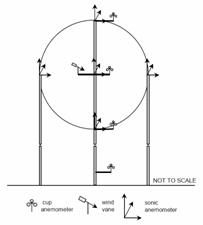
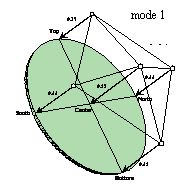
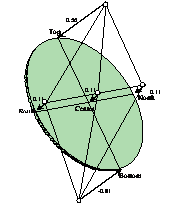
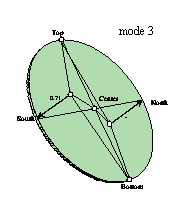
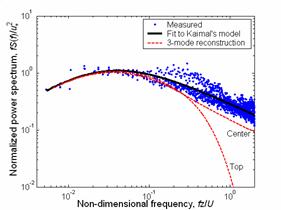
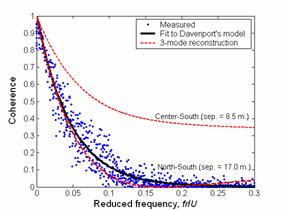
Figures: Primary inflow instrumentation, First three eigenmodes, and
Reconstruction of the PSD and coherence function based on the first three eigenmodes compared with data
